A welder who cannot read a blueprint is a welder who waits for someone else to tell them what to do. On a job site, that is the difference between the person running the project and the person asking questions all day.
At Western Welding Academy, blueprint reading and welding code compliance are not elective add-ons. They are woven into the training from your first weeks on campus. You learn to read welding symbols, interpret procedure specifications, understand joint callouts, and work to code, then you walk into the booth and apply it on real joints.
When you graduate, you will not need a separate blueprint reading course. You will already have the skills that employers test for during the hiring process.
Blueprint reading for welders is the ability to interpret technical drawings, welding symbols, and procedure specifications that tell you exactly what to weld, where to weld it, how to prepare the joint, and what code standard the finished weld must meet.
Every fabrication shop, construction site, and pipeline project runs on drawings. The foreman does not stand next to you and explain every joint. You get a set of prints, a welding procedure specification (WPS), and a code requirement. If you can read them, you work independently. If you cannot, you are the person slowing down the crew.
Our blueprint reading and code compliance training covers eight core modules that prepare you for what you will see on the job:
| Module | What You Learn |
|---|---|
| Welding Symbol Reading | Interpret reference lines, arrows, tails, fillet and groove symbols, weld dimensions, and supplementary symbols on shop drawings |
| Blueprint Views and Lines | Read orthographic projections, isometric views, section views, and identify object lines, hidden lines, center lines, and dimension lines |
| Welding Procedure Specifications | Read and follow a WPS including base metal, filler metal, preheat, interpass temperature, position, and welding parameters |
| Welding Codes Overview | Understand the scope and requirements of AWS D1.1, ASME Section IX, and API 1104 and how each applies to different job types |
| Shop Math and Measurement | Work with fractions, decimals, angles, and tolerances. Read tape measures, calipers, and combination squares to specification |
| Joint Design and Fit-Up | Identify the five basic joint types, proper root openings, bevel angles, and land dimensions from drawing callouts |
| Title Blocks and Bills of Material | Extract project information, material specifications, revision history, and part quantities from standard drawing formats |
| Quality and Inspection Standards | Understand visual inspection criteria, weld acceptance limits, and how code compliance is verified on the job |
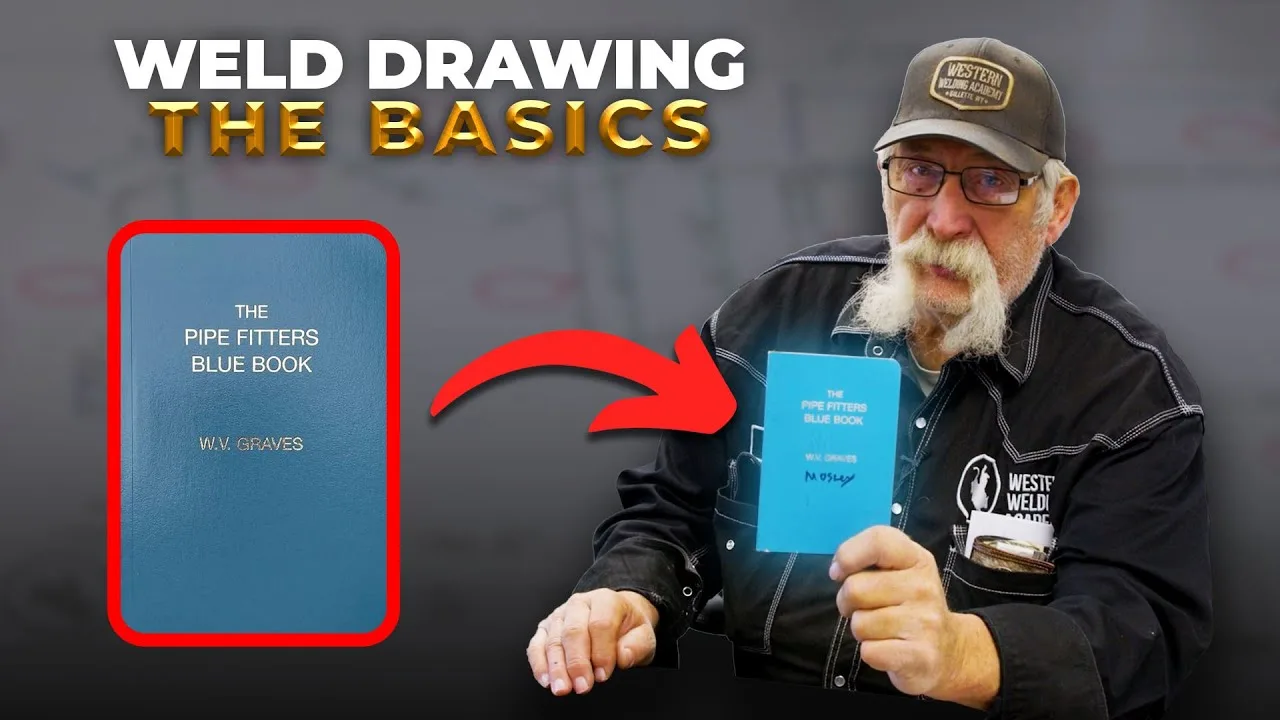
Watch: a Western Welding Academy instructor walks through the basics of reading a weld drawing, the same skills covered in the Welding Symbol Reading and Blueprint Views modules above.
Different industries require different welding codes. A structural fabrication shop works to AWS D1.1. A refinery follows ASME Section IX. A pipeline contractor operates under API 1104. At Western Welding Academy, your program teaches the codes that apply to the career path you are training for.
| Code | Governs | Industries |
|---|---|---|
| AWS D1.1 | Structural steel welding | Construction, bridges, buildings, heavy equipment |
| ASME Section IX | Pressure vessel and piping welds | Refineries, power plants, chemical processing |
| API 1104 | Pipeline welding | Oil and gas transmission, cross-country pipelines |
You will not memorize an entire code book. That is not the goal. The goal is to understand what each code requires of you as the welder: which processes are qualified, which positions you must pass, what acceptance criteria your welds must meet, and how to read the documentation that governs every joint you weld.
Code compliance is not paperwork. It is proof that the weld will hold. Every employer in structural, pipeline, and pressure vessel work expects you to understand the code you are welding to. Our training makes sure you do.
On a construction site or in a fab shop, welders who can read prints get assigned work and go. They do not need a supervisor to explain every joint detail. That independence is what separates a productive welder from one who needs constant direction. Employers notice it immediately.
Employer weld tests often start with a WPS and a drawing. Before you even strike an arc, they want to see that you can read the procedure, identify the joint configuration, and set up your parameters correctly. Welders who fumble through the paperwork raise red flags before they ever touch a torch.
A weld that does not match the drawing or violates the code gets cut out and redone. That costs time, material, and credibility. Welders who understand the specs produce code-compliant work the first time, which is how you build a reputation and move up.
Foremen, lead welders, and welding inspectors all need strong blueprint reading skills. The career path from booth welder to supervision runs directly through your ability to interpret drawings and codes. Starting with these skills gives you a head start on advancement.
Blueprint reading and code compliance are not a separate class you sit through once. They are part of the 15% classroom instruction that supports every phase of your hands-on booth training. Here is how it works:
By the end of your program, reading a WPS and interpreting a welding drawing is automatic. It is not something you need to think about. It is how you work.
No matter which path you choose, you graduate with these skills:
| Program | Duration | Total Cost | Blueprint and Code Training |
|---|---|---|---|
| Foundational Pipe Welder | 12 Weeks | $17,050 | Yes |
| Professional Pipe Welder | 19 Weeks | $27,600 | Yes |
| Expert Pipe Welder | 24 Weeks | $35,800 | Yes |
| Advanced Structural Welding | 12 Weeks | $25,800 | Yes |
Every pipe welding program certifies to AWS D1.1 and ASME Section IX, and the Expert Pipe Welder adds API 1104. The Advanced Structural Welding program certifies to AWS D1.1 on plate and pipe. All students learn blueprint reading, WPS interpretation, and the fundamentals of welding code compliance.
Most people think a welding hire test is just a weld coupon. It is not. Here is what happens at a typical employer qualification test:
Welders who can read blueprints, follow procedures, and weld to code are the ones who get hired first and advance fastest. Here are verified paychecks from real graduates.
All earnings verified by graduate-submitted paychecks.
These graduates trained at Western Welding Academy with the same blueprint reading and code compliance curriculum described on this page. Their skills in the booth and on paper are what put them in these positions.
No hidden fees and no surprise material charges. Tools and safety gear are included in every program, and furnished student housing is included in every pipe welding program.
No prior welding experience required.
Submit your online application. Takes about 10 minutes.
Receive your admission decision from our team.
Submit your Booth Hold Payment to lock in your start date.
Review and sign enrollment documents.
Finalize tuition funding before your first day.
No previous welding experience is needed. Blueprint reading and code compliance training is included in every program, from the Foundational Pipe Welder through the Expert Pipe Welder and Advanced Structural Welding tracks.
Every welding job starts with a drawing and a set of specifications. The welders who can read them, follow them, and produce code-compliant work are the ones who stay employed and move up. At Western Welding Academy, those skills are built into your training from day one. Apply today and start building the complete skill set that employers are looking for.
Western Welding Academy is the only pipe welding school in the country that is solely owned and operated by real pipeline/pipe welders. At WWA we have the most elite, highest skilled welders in the world teaching students how to weld.
(307) 284-5313