What Leads to Skill Gaps in Core Welding Techniques for Working Welders?
Welding skill gaps do not appear overnight. They build over months and years of doing the same work the same way. A welder who runs MIG in a fabrication shop 50 hours a week does not notice their stick skills fading until they try to pass a certification test and fail. The gap is real. Understanding what causes it is the first step toward closing it.
Single-Process Specialization
This is the most common cause of skill gaps in working welders. A welder who uses one process exclusively for years loses proficiency in every other process. MIG welders lose stick and TIG skills. Stick welders who never learned TIG cannot run a GTAW root pass. The processes use different motor skills, different hand coordination, and different visual cues. Without practice, those neural pathways weaken.
The pay impact is direct. MIG-only welders are capped at $38,000 to $55,000 in production roles. Adding SMAW and GTAW opens pipe welding at $60,000 to $125,000+. That is not a marginal increase. It is a career-tier jump that requires closing a process gap. Learn more about the pay difference certifications make.
Repetitive Position Work
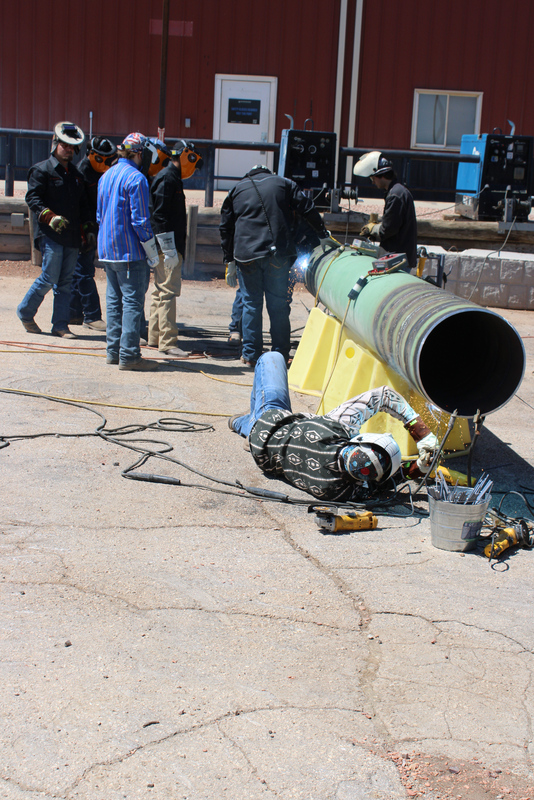
A shop welder who welds flat and horizontal every day loses the ability to weld vertical and overhead. The body mechanics are completely different. Gravity works against you in overhead position. Puddle control changes in vertical. Without regular practice in all positions, muscle memory for non-routine positions decays.
Certification tests require multi-position proficiency. A welder who cannot pass a 3G or 4G plate test, or a 5G or 6G pipe test, is locked out of the pay tiers those certifications open. The difference between a welder who can pass horizontal and a welder who can pass 6G overhead pipe is a $40,000 to $60,000 annual raise.
Speed-Over-Quality Production Culture
Production environments reward throughput. Over time, welders develop habits that prioritize speed: longer arc lengths for faster travel, insufficient preheat, skipping tack sequences, and pushing amperage higher than optimal. These shortcuts produce acceptable welds under production tolerances but fail under code inspection standards.
A welder trained in production speed who attempts a code weld test often fails on defects they did not know they were producing: porosity, undercut, incomplete fusion, or excessive reinforcement. The gap between production quality and code quality is invisible until the test exposes it.
Recognize any of these gaps? Call Western Welding Academy at (307) 284-5313 or apply now to close them in 12 to 24 weeks.
No Formal Initial Training
Many working welders learned on the job or through abbreviated programs that covered one process in one or two positions. They were never taught the full range of fundamentals: blueprint reading, weld symbols, joint preparation, heat input calculations, or multi-process technique. The skill gaps were present from the start. They just did not matter until the welder tried to advance beyond their current role.
This is especially common among welders who are now considering a basic welding course to tighten fundamentals. The course does not teach them something new. It fills in what was never covered in the first place.
Equipment and Technology Changes
Welding equipment evolves. Advanced waveform GMAW, pulsed TIG, and new low-hydrogen electrodes require updated technique. A 2024 AWS survey by Weld-Ed found that advanced waveform GMAW was the number one skill gap cited by industry representatives. Welders trained on older equipment may not have the technique for newer machines, and employers assume they do.
This gap is harder to self-diagnose because the welder may believe they are proficient on the new equipment when their technique is actually compensating for unfamiliar machine behavior. Read the companion piece on the six causes behind welding technique skill gaps for more on how technology shifts create hidden deficiencies.
Lack of Ongoing Training Culture
Most welding employers do not invest in ongoing skills development. The expectation is that you arrived with the skills and you maintain them on your own. But skills that are not deliberately practiced degrade. Without a structured retraining path, working welders plateau and their fundamentals slowly erode.
That is why Western Welding Academy offers lifetime retraining for all graduates. If your skills decay after years in the field, you return to campus and train at no additional cost. It is the only ongoing skills maintenance program in the pipe welding trade school space. No other school offers this benefit. Learn more about how refresher courses accelerate career advancement.
How to Identify Your Own Skill Gaps
The fastest way to diagnose your skill gaps is to ask yourself six direct questions. Each one targets a specific gap area. If you answer no to any of them, you have identified where your technique has decayed.
Can you pass a 6G pipe test right now? If the answer is no, the gap is multi-position pipe welding. This is the single most common gap among working welders and the one with the largest pay impact. Closing it requires sustained all-position booth time with instructor correction.
Have you used TIG in the last 12 months? If the answer is no, the gap is GTAW proficiency. TIG technique decays faster than stick because it requires finer motor control. A welder who has not run TIG in over a year will need focused retraining to rebuild torch control, filler feeding, and foot pedal heat management.
Can you weld overhead consistently for 30 minutes? If the answer is no, the gap is overhead position endurance. Overhead is the position that decays first and takes the longest to rebuild. It requires body mechanics and puddle reading skills that flat and horizontal work do not maintain.
Can you read an AWS welding symbol and prep the joint correctly? If the answer is no, the gap is blueprint reading and joint preparation. This gap is common among welders who learned entirely on the job without formal instruction. Every code job site requires symbol literacy.
Can you switch from MIG to stick and maintain quality? If the answer is no, the gap is SMAW arc control. Switching processes requires different hand coordination, visual tracking, and heat management. A welder who cannot transition cleanly between processes has a process-specific gap.
Have you failed or avoided a weld test in the last two years? If the answer is yes, the gap is the process and position of that test. Avoidance is a gap signal. The test you are not willing to take is the test that identifies your weakest area.
What Graduates Earn After Closing Their Gaps
The numbers below come from verified Western Welding Academy graduate records. These are real paychecks from welders who closed their skill gaps through focused retraining.
Leyton Wagner earns $4,514 per paycheck as a verified Western Welding Academy graduate. His paycheck is published on the Western Welding Academy website. That single check exceeds what many MIG-only shop welders earn in a month.
Gavin Walden earns $3,986 per paycheck. His verified earnings confirm that the $3,500 to $4,500 per-check range is a consistent outcome for graduates who closed their gaps and entered pipe welding with the right certifications. See the full breakdown of what pipe welders actually earn after graduation.
David Smolek earns $3,417 per paycheck. Even at the lower end of the verified graduate range, his biweekly earnings translate to roughly $88,000 per year. That is a $38,000 annual jump over a $50,000 MIG production welder paycheck.
Noah clears $2,800 per week welding on the North Slope in Alaska. Pipeline and remote location premiums push earnings even higher for graduates willing to travel.
Hank reached $150,000 per year by age 21. He completed the Expert Pipe Welder program, earned his certifications, and entered the workforce with every gap closed and every credential in place.
Find your gap. Fix it. Call Western Welding Academy at (307) 284-5313 or apply now to start retraining.
Frequently Asked Questions
Q1. Do experienced welders really have skill gaps?
Yes. Every welding skill that is not regularly practiced will degrade over time. Single-process specialization and single-position work are the most common causes. A welder who runs MIG flat and horizontal for five years will have significant gaps in SMAW, TIG, and multi-position technique.
Q2. How do I know if I have a skill gap?
Try to pass a weld test at the next certification level. If you fail, the deficiency the inspector identifies is your gap. If you avoid taking the test entirely, the process and position you are avoiding is where the gap exists.
Q3. Can skill gaps be fixed quickly?
Yes, with focused booth time. Twelve weeks of full-time SMAW training at Western Welding Academy rebuilds pipe welding fundamentals in all positions. The Expert program covers both SMAW and GTAW through 6G in 24 weeks.
Q4. Does Western Welding Academy accept experienced welders with gaps?
Yes. All programs serve beginners and experienced welders alike. Experienced welders progress faster through familiar material while the program ensures every fundamental and every position is addressed. Lifetime retraining is included for all graduates.
Q5. What is the pay difference between having gaps and closing them?
MIG-only production welders with gaps earn $38,000 to $55,000. Welders who close their gaps and earn pipe certifications reach $60,000 to $125,000+. The annual pay difference is $20,000 to $70,000 depending on the certifications earned and the work sector entered.
Q6. What makes Western Welding Academy different from other welding schools?
Western Welding Academy delivers 85% booth time, all-inclusive tuition covering housing, tools, and materials, lifetime retraining for every graduate, 330 combined years of instructor pipeline experience, and a 94% hire rate within 90 days verified by a 234-alumni survey. It is the #1 AWS Accredited Testing Facility in the country.
Close the Gap and Unlock Your Next Career Tier
Every skill gap has a fix. The fix is focused booth time with experienced instructors who can see what you cannot feel. Western Welding Academy closes those gaps in 12 to 24 weeks with 85% hands-on training. Call Western Welding Academy at (307) 284-5313 or apply now to start closing the gap between where you are and where your skills can take you.
.jpg)
.jpg)


.jpg)
.jpg)
.jpg)
.jpg)
.jpg)
-thumbnail.jpg)

.jpg)